Cooling-RF Guard
This idea was originally implemented by Tatsumi, JH2CLV.
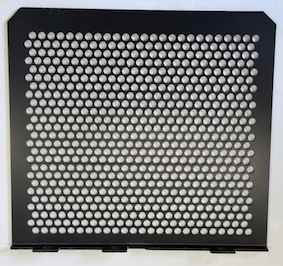
This photo shows the Kenwood RF shield – (baffle plate) removed from the amplifier.
When you look at the tube compartment and consider the way the fan exhausts the hot air out of the compartment, you notice that Kenwood placed a black perforated baffle (RF shield really) in the direct path of tubes, impeeding heat being drawn out of the compartment. Some air can be drawn directly through the perforations, but the path of least resistance is likely around the edges of the RF shield and not necessarily drawing the bulk of the airflow over the tubes in a direct manner.
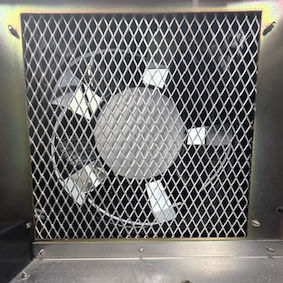
What Tatsumi did was to remove the original shield and replace it with a stainless mesh with larger perforations and sandwich it between the back plate of the amplifier and the fan cover. The new mesh is able to be screwed in place without any new hardware or metal work required from the fan side. The fan and cover is re-installed over the new RF shield. I copied this but used aluminium mesh rather than stainless steel.
The new mesh has larger holes for increased airflow. It will have an unobstructed pull on air directly past the tubes. The replacement screen continues to provide the RF shielding needed. The next photo is just for comparative purpose. It shows the original shield in front of the new shield.
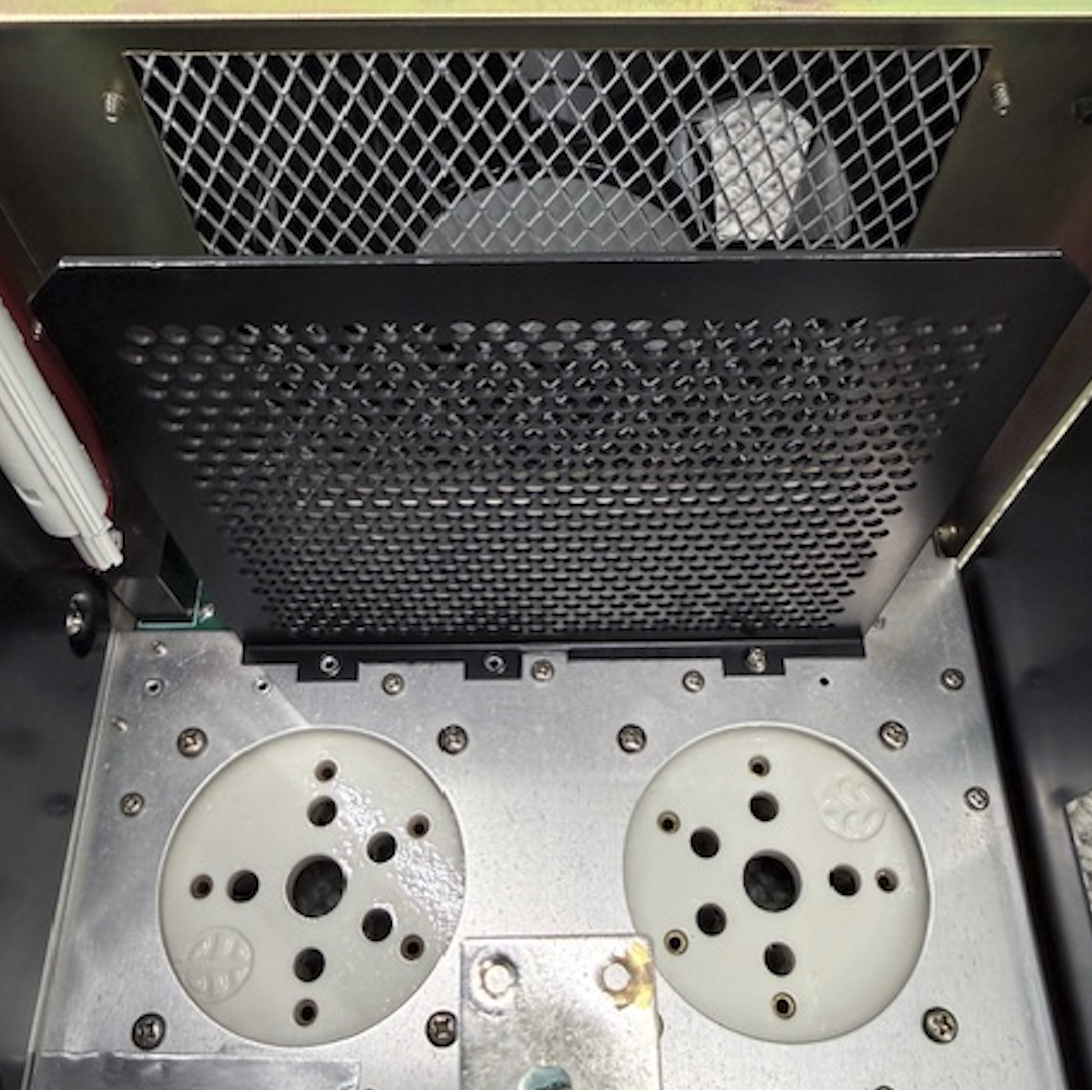
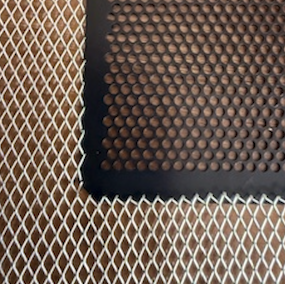
A close up, by way of a comparison of the two shields. Better airflow is expected through the new mesh.
I received a great email from Gene W1EBR. He mentions another excellent point. The tubes are also cooled by radiating heat in the Infra-Red spectrum. It makes perfect sense that the internal walls of the tube compartment and this shield were painted black so that they absorbed heat, reflected little, and contributed to the cooling. This is a great point. I think I will be painting my new screen black the next time I am mucking around with the amplifier. My special thanks Gene.
Is this mod important? Perhaps not. There are thousands of these TL-922’s that never seemed to suffer from getting too hot. Some did of course, but the vast majority just coped. That being said, I have been quite astonished that the tubes in the TL-922 seem to be able to run at full power, despite what appears as minimal airflow past the tubes and socket pins. In an article written by HB9ANY and published, it stated. The TL-922 is rated for up to 30 minutes continuous operation at 2kW on SSB, or up to ten minutes continuous key-down at 1kW on CW, RTTY and data modes. I know that some have proved this to be so, by giving the finals a caning. Pushing the tubes hard means that you risk exceeding the maximum temperatures for the anode and socket pin seals. This is not a good outcome. So, improving the cooling is a benefit, and this modification might accomplish it without any increase in fan noise.
I consider this, a super simple mod that might improve airflow past the tubes. It was not hard to do. Once I had the mesh in hand, it only took an hour to complete. Perhaps you might also like to try it.
Image credits: VK3BBQ